LA28’s Rose Bowl Aquatics Center Fits The Bill For Olympic Diving
LA28 Olympic Games organizers promised to reuse existing facilites.. The Rose Bowl Aquatics Center may be one of the clearest examples yet of that philosophy in action.
By Cyrus Team ·
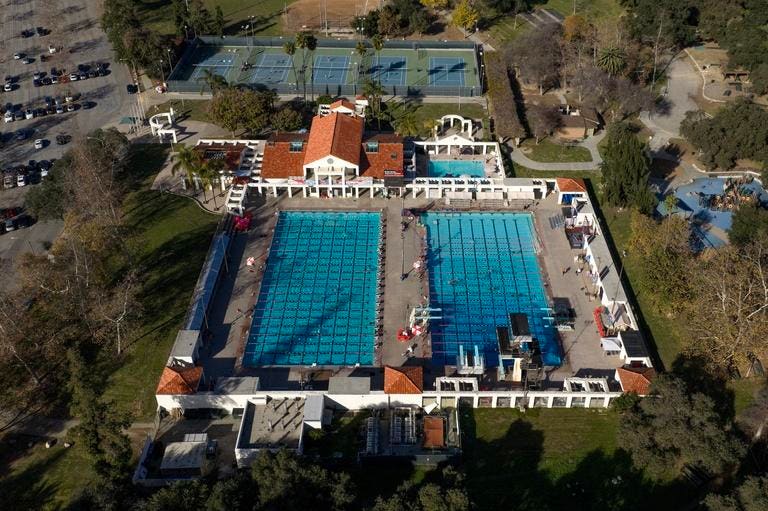
When Los Angeles won the right to host the 2028 Olympic Games, organizers promised something that has become increasingly rare in the Olympic movement: use what already exists. The decision to relocate Olympic diving to the Rose Bowl Aquatics Center in Pasadena may be one of the clearest examples yet of that philosophy in action.

In September 2025, the Los Angeles City Council unanimously approved LA28’s proposal to move diving from Exposition Park to the Rose Bowl Aquatics Center. The change is expected to generate as much as $17.6 million in combined cost savings and revenue growth while reducing operational complexity and improving athlete safety. The venue already meets many international standards and requires only limited modifications to host the world's best divers in 2028.
For Olympic planners, it is a practical decision.
For historians, it is yet something more.
The Rose Bowl Aquatics Center represents a remarkable continuum of Southern California history—from Pasadena’s segregated public swimming era, through the Olympic boom generated by the 1984 Los Angeles Games, to LA28’s effort to demonstrate that major sporting events can rely on legacy infrastructure rather than expensive new construction.
A Full-Circle Olympic Legacy
One of the more overlooked aspects of the Rose Bowl Aquatics Center story is that the facility itself exists because of the success of the 1984 Los Angeles Olympics.
Unlike many host cities that accumulated debt, the 1984 Games generated a surplus that funded community sports facilities throughout Southern California. The Rose Bowl Aquatics Center, which opened in 1990 adjacent to the iconic Rose Bowl Stadium, was one of the beneficiaries.
"The RBAC itself was born out of the 1984 Olympic Games, built with funds left over from that historic moment in Los Angeles," Rose Bowl Aquatics Center Executive Director Melanie Sauer said when the venue selection was announced.
That statement captures why the decision resonates beyond venue planning.
The 1984 Games created a legacy asset. Four decades later, that legacy asset will host an Olympic competition.
In an era when Olympic organizers face increasing scrutiny over construction costs, the Rose Bowl Aquatics Center provides a tangible example of how one generation’s Olympic investment can serve another. The facility already includes two Olympic-sized pools and has hosted elite aquatic events, including U.S. national diving championships and training camps for Olympic athletes.
Rather than constructing a temporary venue that would disappear after the Closing Ceremony, LA28 is adapting an existing facility that has served Southern California swimmers and divers for decades.
Before The Aquatics Center, There Was The Plunge
Long before Olympic divers arrived in Pasadena, the site carried a much different identity.
The area adjacent to the Rose Bowl was once home to the Brookside Plunge, one of Southern California's most popular municipal swimming facilities during the early twentieth century.
Opened in the 1920s as part of Pasadena's Brookside Park recreational complex, the Plunge became a centerpiece of community life. Thousands of residents learned to swim there, attended competitions, and escaped Southern California's summer heat.
Yet the facility also reflected one of the darker realities of American public recreation.
Like many public pools across the United States during the first half of the twentieth century, the Brookside Plunge operated under discriminatory practices that effectively excluded African Americans and other minorities from equal access.
Pasadena's struggle over segregation in public facilities became one of the city's defining civil-rights battles. Community activists, including Dr. Edna L. Griffin—widely recognized as Pasadena's first Black female physician—played a significant role in challenging discriminatory practices at local recreational facilities, including the Plunge.
The story mirrors a broader national history.
Across America, swimming pools often became flashpoints in the fight for civil rights because they represented some of the most visible public spaces where segregation was enforced. The eventual desegregation of Pasadena's public swimming facilities marked an important chapter in the city's evolution.
Today, few visitors arriving for a swim at the Rose Bowl Aquatics Center realize they are entering a location connected to that larger struggle.
The LA28 Model
The Rose Bowl Aquatics Center decision also highlights a larger trend shaping the Los Angeles Games.
LA28 has consistently emphasized venue reuse over venue construction.
The organizing committee has repeatedly pointed to existing facilities throughout Southern California as evidence that Los Angeles can host the Olympics without the massive building spree that has burdened many previous host cities. The diving relocation embodies that approach. According to LA28, the Pasadena venue requires fewer improvements than the previously proposed site, offers enhanced athlete amenities, and provides greater certainty in budgeting. The move also addresses athlete safety concerns identified during planning reviews.
That may not generate the same excitement as unveiling a billion-dollar stadium, but Olympic cities increasingly want Olympic benefits without Olympic-sized debt.
A Legacy Nearly A Century In The Making
By the summer of 2028, spectators watching Olympic divers launch from a platform in Pasadena may see only a beautifully staged sporting event against the backdrop of the Arroyo Seco. What they may not see is the nearly century-long story beneath the water. The site's history stretches from the Brookside Plunge and Pasadena's segregation battles, through the optimism of the 1984 Los Angeles Olympics, to an era in which Olympic organizers are trying to prove that existing facilities can still deliver world-class competition.
For LA28, the Rose Bowl Aquatics Center is more than a diving venue. It is a great example of what Olympic legacy can look like when it works. The facility was born from the profits of one Olympic Games, served generations of community athletes, and now will take the Olympic stage forty-four years later.
Sometimes the best Olympic venue is not the one that needs to be built.
It is the one that has already spent decades serving its community.